





Skin
Rosacea & Facial Redness
Used during a flare, when the skin cannot tolerate anything more active.
Explore skin
Care starts with your skin, not a treatment name.
Explore injectables
A medical consultation and an individual approach.
Explore face & body
Explore options for contour, muscle and firmness.
Explore concerns
You do not need to know the treatment. Tell us your concern.

Explore skin
Care starts with your skin, not a treatment name.
Explore injectables
A medical consultation and an individual approach.
Explore face & body
Explore options for contour, muscle and firmness.
Explore concerns
You do not need to know the treatment. Tell us your concern.

Clinical light therapy
Twenty minutes under clinical-grade light at our Berkhamsted clinic, with no heat, minimal downtime and most patients drifting off to sleep. The treatment Anna reaches for when skin is too inflamed or too reactive for anything else, and the one that makes everything else work better.
Dermalux LED bathes the whole face in three precise wavelengths of light. Blue at 415nm is used for breakout-prone skin, red at 633nm settles inflammation and wakes up the fibroblasts that make collagen, and near-infrared at 830nm reaches deepest and is used to support skin recovery. The cells absorb the light and turn it into energy, nothing is heated and nothing is damaged, which is why you walk straight back out into your day.
Skin
Used during a flare, when the skin cannot tolerate anything more active.

Skin
A calming light treatment for breakout-prone skin, with no heat and nothing absorbed.

Skin
A steady lift in skin quality and tone, and a treatment that makes everything it runs alongside work harder.


Clinical case image supplied by Dermalux (Dermalux Tri-Wave MD). Images courtesy of Beautiful You, Prescot. Individual results may vary.


Clinical case image supplied by Dermalux (Dermalux Tri-Wave MD). Images courtesy of Sofie Georgia, Cambridge. Individual results may vary.
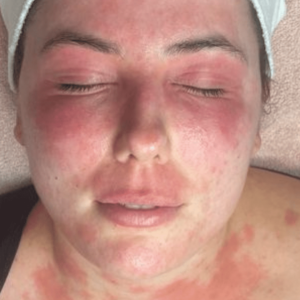

Clinical case image supplied by Dermalux (Dermalux Flex MD). Images courtesy of Sur Medispa, Glasgow. Individual results may vary.


Clinical case image supplied by Dermalux (Dermalux Flex MD). Images courtesy of Eletha Skin, Bristol. Individual results may vary.
Clinical light, at clinical strength.
The Dermalux panel delivers considerably more energy at precise wavelengths than any mask sold for home use.
The light is absorbed by cells and converted into cellular energy. Nothing is heated and nothing is damaged.
Inflammation and redness reduce within two or three sessions, which is why patients in a flare notice it early. Acne improves progressively across the course.
Twice weekly for a course of six to twelve. Most of the value comes from combination: LED after microneedling helps skin feel calmer, LED alongside an acne course calms inflammation between laser sessions, and LED after a peel shortens the flaking phase.
You lie under the panel with eye protection on. The light reaches the whole face at once, so there is no application point to choose.

Blue light is used for breakout-prone skin, red light reduces inflammation and stimulates collagen, near-infrared reaches deepest to support skin recovery. All reach the whole face together.
Twenty to thirty minutes of gentle warmth, twice weekly for a course of six to twelve. No heat, minimal downtime, no sensation beyond warmth.
Your therapist confirms the concern, sets the wavelength programme and agrees the course length with you.
What you feel or see A short conversation about the concern.
What to do Mention any other treatments you are having, because LED pairs beautifully with them.
Your therapist confirms the concern, sets the wavelength programme and agrees the course length with you.
What you feel or see A short conversation about the concern.
What to do Mention any other treatments you are having, because LED pairs beautifully with them.
Twenty to thirty minutes lying under the panel with eye protection.
What you feel or see Gentle warmth. Most patients fall asleep.
What to do Nothing to plan around.
No redness, no restriction, makeup straight back on.
What you feel or see Calm, warm skin.
What to do Carry on with your day.
Inflammation and redness reduce within two or three sessions, which is why patients in a flare notice it early.
What you feel or see Calmer, less red skin.
What to do Keep to twice weekly.
Six to twelve sessions, usually twice weekly, then maintenance or sessions woven into other treatments. Acne improves progressively across the course, and skin quality and tone lift steadily week by week.
What you feel or see Steady improvement across the weeks.
What to do Pair it with microneedling, peels or laser where that is the plan.
Results hold while the underlying condition is managed. Acne and rosacea are long-term conditions, and LED earns its keep as the calming constant inside a wider plan.
What you feel or see Calm skin, held while the plan continues.
What to do Keep the wider plan going.
Your therapist confirms the concern, sets the wavelength programme and agrees the course length with you.
Twenty to thirty minutes lying under the panel with eye protection.
No redness, no restriction, makeup straight back on.
Inflammation and redness reduce within two or three sessions, which is why patients in a flare notice it early.
Six to twelve sessions, usually twice weekly, then maintenance or sessions woven into other treatments. Acne improves progressively across the course, and skin quality and tone lift steadily week by week.
Results hold while the underlying condition is managed. Acne and rosacea are long-term conditions, and LED earns its keep as the calming constant inside a wider plan.
The calming constant inside a wider plan.
Inflammation and redness reduce within two or three sessions, across a course of six to twelve.
Every patient is assessed by a qualified clinician, a doctor, nurse or other qualified practitioner, before anything is booked.

Aesthetic Therapist
Over twenty years in beauty and aesthetics, specialising in body contouring, radiofrequency, laser hair removal and HydraFacial.

Founder, Lead Clinician & Advanced Nurse Practitioner
Award-winning aesthetic nurse practitioner with more than twenty years of specialist NHS nursing and over a decade in advanced aesthetic medicine. Qualified independent prescriber.
The right choice depends on your skin and what you are treating; a consultation settles it.
| MicroneedlingSkinPen, micro pins only | Chemical peelsMedical-strength acids | |
|---|---|---|
| On its own | 24 to 48 hours of redness | 24 hours to 5 days of flaking, by depth |
| With Dermalux after | Reduces redness and speeds recovery | Shortens the flaking phase |
| Explore microneedling | Explore chemical peels |
This is where Dermalux shines. Mention any other treatments you are having, because LED pairs beautifully with them.
Session20 to 30 minutes
Course6 to 12 sessions, twice weekly
DowntimeNone
Your plan and the number of sessions are agreed at your consultation, before anything is booked.
A clinical light treatment that bathes the whole face in three precise wavelengths. Blue light is used for breakout-prone skin, red light settles inflammation and stimulates collagen, and near-infrared reaches deepest to support skin recovery. The cells turn the light into energy; nothing is heated and nothing is damaged.
For breakout-prone and reactive skin, many patients find it calming, and your therapist explains what to expect at consultation. For lines and laxity the effect is a gentle lift in skin quality, and it does its best work woven into a wider plan.
Skin that cannot tolerate anything else: rosacea in flare, acne that is inflamed and sore, skin recovering from a peel or laser, and skin so reactive that every active product stings. It is also the treatment that makes every other treatment at our Berkhamsted clinic work harder, which is why Anna adds it so often.
A different league. The Dermalux panel delivers considerably more energy at precise clinical wavelengths, which is where the results come from. A home mask has a place for maintenance between visits.
£50 a session at our Berkhamsted clinic, with courses of six to twelve and add-ons to other treatments quoted at consultation.
Six to twelve, usually twice weekly, then maintenance or sessions added to other treatments. Inflammation and redness tend to settle within the first two or three.
Twenty to thirty minutes lying under the panel with eye protection on. The light reaches the whole face at once, so there is nothing to apply and nowhere to aim.
None. No redness, no restriction, and make-up goes straight back on.
Not at all. You feel gentle warmth, most patients find it deeply relaxing, and a good many fall asleep.
Yes, and that is often exactly when we use it. It calms inflammation when the skin cannot tolerate anything more active, and many patients find it soothing.
LED targets no pigment and generates no heat, so it suits most skin tones after a skin check.
Your therapist sets the programme for your concern. Blue for active acne, red for inflammation, rosacea and skin quality, near-infrared for recovery after microneedling, peels and laser, and often a combination within one session.
Yes, and this is where Dermalux shines. After microneedling it helps skin feel calmer, after a peel it shortens the flaking phase, and alongside an acne course it keeps inflammation calm between sessions.
Blue light is chosen for breakout-prone skin and red light for calming, and your therapist reviews progress across the course. Acne is a long-term condition, so LED does its best work as part of a plan that may also include peels or laser.
Red light stimulates the fibroblasts that make collagen, so skin quality and tone lift gently across a course. For deeper lines and laxity, Exion and EmFace at our Berkhamsted clinic do the heavy lifting, with LED speeding recovery between.
Keep to twice weekly through the course, tell your therapist about any other treatments you are having so the two can be timed together, and keep the wider plan going once the course ends. The team is a phone call away afterwards.
Anna Stenekova and our skin therapists at our Berkhamsted clinic, after a short consultation that sets the programme for your skin.
113 High Street, Berkhamsted HP4 2DJ, a short walk from the station and a short drive from Tring, Hemel Hempstead, Chesham and Amersham.
Every plan starts with an assessment rather than a booking. If another treatment would serve you better, that is what we will recommend.
Tell us what you’d like to achieve. Regents Park Aesthetics will be in touch within one working day to arrange your consultation.
