Rolling acne scars forming shallow dips across the cheek

Skin concerns · London

Acne Scarring

Four different things get called acne scarring, and each has its own treatment. A close look at Wimpole Street tells you which you have, so the first course you book is the one that works.

At a glance

  • Types Rolling, boxcar, ice pick, pigment marks
  • Treated at Wimpole Street, London
  • Typical course 3 to 6 sessions
  • Downtime None to 7 days by treatment
  • First step Consultation and skin assessment

What it is and why it happens

The acne cleared years ago, yet the marks on your cheeks still catch the light in a selfie or under the bathroom mirror. That texture sits deeper than anything sold in a pharmacy can reach, which is exactly where clinic treatment begins.

Acne scarring is really four conditions under one name, each at its own depth and each with a treatment that transforms it. Flat brown or red marks are colour rather than scars in the strict sense, and they fade beautifully with peels, while a pitted scar needs treatment that works deeper. An ice pick scar is a narrow channel running deep into the dermis and needs something that reaches it.

Regents Park Aesthetics assesses which types you actually have, usually a mix, before recommending anything. The deepest resurfacing devices are at our Wimpole Street clinic in the Harley Street medical district. Microneedling and peels are offered alongside them.

Why acne leaves scars in the first place

A scar forms when inflammation reaches the dermis. Surface spots that stay in the epidermis heal without a trace. Once inflammation breaks through into the deeper layer, the body repairs with collagen, and the repair is rarely a perfect match for what was there.

Healing can go two ways. Where it lays down too little collagen, the skin sits lower than the surrounding surface. That is a pitted or atrophic scar. It covers rolling, boxcar and ice pick types, and accounts for the large majority of acne scarring. Where it lays down too much, the scar sits raised, which is more common on the chest, shoulders and jawline and is treated quite differently.

Depth of the original lesion predicts the scar type. Nodular and cystic acne reaches furthest and leaves the deepest scarring, which is why calming severe acne early matters so much for the skin’s future. Picking and squeezing pushes inflammation deeper into the dermis and reliably makes scarring worse, which is the one piece of prevention entirely within anyone’s control.

Genetics decides how you heal, and skin tone influences what you are left with. Deeper skin tones are more likely to be left with post-inflammatory hyperpigmentation alongside any textural scarring. Treatment plans at Regents Park Aesthetics therefore often run a pigment strand and a texture strand at the same time.

Post-inflammatory marks and scarring along the jaw and cheek
Know your type

Which type is yours?

Rolling scars

Soft, shallow dips with sloping edges

Rolling scars

Wave-like undulations that show up most in raking side light and often look worse in photographs than in the mirror. They are caused by fibrous bands tethering the skin down from below, which is why treatments that work at depth release them so well.

Boxcar scars

Round or oval, sharply defined edges

Boxcar scars

Wide craters with steep walls, most common on the cheeks and temples. They sit in the mid dermis. Fractional resurfacing works by ablating the rim so the edge softens and the eye stops reading it as a hole.

Ice pick scars

Narrow, deep, like a pinprick

Ice pick scars

The most technical type. A very narrow channel running deep into the dermis, so treatment is focused precisely on each one, and these are often the reason a course includes more than one device.

Post-inflammatory marks

Flat brown, red or purple patches

Post-inflammatory marks

Colour rather than true scarring. Skin texture is intact and only the colour has changed, left behind by the inflammation. Medical peels are the first-line answer, and these marks lift faster than any other type.

How we assess and treat

Assessment at Regents Park Aesthetics is done in raking side light, because overhead lighting flattens texture and hides exactly what we are trying to measure. We map which scar types are present and in what proportion, note the depth and the edge quality, record your Fitzpatrick skin type, and ask whether the acne itself is genuinely settled.

That last question decides the timing. Scar treatment works best on calm skin, so where breakouts are ongoing, your clinician helps you settle them first and then starts the scar plan.

Skin type decides the device. On deeper skin tones, Regents Park Aesthetics favours Morpheus8 or microneedling, which work on texture without targeting pigment, so most skin tones have a strong route to smoother skin after a skin check.

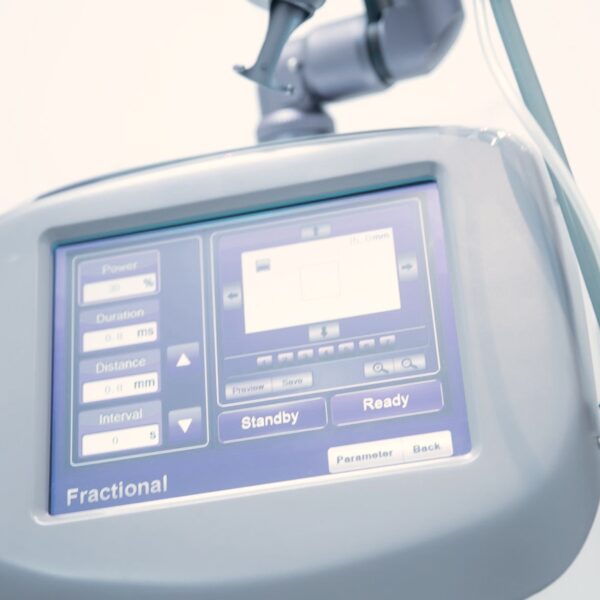
The fractional CO2 laser control screen in the Wimpole Street clinic
Your options

Which treatment for your type of acne scarring?

As a guide, this is how we typically match each type to a treatment. Your own plan is always confirmed at consultation, and where a type is best seen by a dermatologist, your clinician points you to the right door.

Type
Recommended treatment
Why
Rolling scars
Radiofrequency needling rebuilds collagen under a shallow, sloping scar
Boxcar scars
Resurfacing softens the sharp shoulder that casts the shadow
Ice pick scars
A depth that reaches a narrow tract, with clear expectations agreed together
Post-inflammatory marks
Pigment, not scarring, so it clears with resurfacing and daily SPF

Treatments that address it

CO2 Laser Resurfacing The most powerful resurfacing option we have, and the one that shifts boxcar and ice pick scarring. It removes microscopic columns of damaged tissue so fresh collagen rebuilds the skin. Morpheus8 Radiofrequency delivered up to 4mm deep, reaching the fibrous bands tethering rolling scars from below. A favourite for soft, undulating scarring and for deeper skin tones. SkinPen Microneedling The steady workhorse. Controlled micro-injuries stimulate collagen through the scarred area, improving shallow rolling scars and overall texture across a course, with minimal downtime. Chemical Peels Works on the colour rather than the crater. Medical-strength peels lift post-inflammatory pigment and improve surface texture, and they are often run alongside a resurfacing course
Morpheus8 handpiece applied to the face during treatment Practitioner applying a chemical peel mask with a brush
£300 £500 £350 £120
Boxcar and ice pick scars Rolling scars, lax tissue Shallow rolling scars, texture Post-inflammatory pigment
Surface to mid dermis, ablative Up to 4mm, radiofrequency 0.5 to 2.5mm Surface
1 to 3 sessions 3 sessions 4 to 6 sessions 4 to 6 sessions
5 to 7 days 2 to 3 days 24 hours 24 to 48 hours
Assessed case by case Safe, no pigment target Safe Safe with medical-grade formulations

Sequencing more than one treatment

Most people have more than one scar type, so most plans use more than one device. A typical plan at Regents Park Aesthetics runs two strands.

The texture strand targets the pits. Where scarring is soft and rolling, that means Morpheus 8 reaching the fibrous bands tethering the skin from below. Where it is sharply cratered, it means fractional CO2 laser ablating the rim so the edge softens. Where it is shallow throughout, microneedling across a course does the job with far less downtime.

The pigment strand targets the colour left behind, using medical peels and disciplined home care. This strand often produces the first visible change, because post-inflammatory marks lift faster than texture rebuilds, and it is the reason people frequently feel progress before the scarring itself has moved much.

Sequencing matters. Regents Park Aesthetics leaves four to six weeks between resurfacing sessions so collagen can lay down, and lets the skin recover fully from laser before any peel. A full plan runs six to nine months, and the final assessment happens three months after the last session because collagen keeps building long after treatment stops.

A medical peel kit and vial laid out on the treatment room counter

Before and after

Cheek before a course of SkinPen microneedling, with deep rolling acne scars and uneven texture
Before
The same cheek after a course of SkinPen microneedling, the scars shallower and the surface more even
After
Acne scarring
Cheek, after a course of SkinPen

Pitted scarring on the cheek after a course of SkinPen microneedling. Clinical image supplied by Crown Aesthetics. Individual results may vary.

Cheek before Morpheus8, with pitted acne scarring across the mid face
Before
The same cheek after Morpheus8, with the scarring shallower and the surface more even
After
Acne scarring
Cheek, after Morpheus8

The same concern treated with radiofrequency microneedling, which reaches deeper than needling alone. Clinical image supplied by InMode. Individual results may vary.

Cheek and jawline before SkinPen microneedling, with clustered spots and pigmented marks
Before
The same cheek and jawline after SkinPen microneedling, clear and even in tone
After
Post-acne marks
Face, after SkinPen

The flat brown and red marks acne leaves behind, which respond faster than true scarring. Clinical image supplied by Crown Aesthetics. Individual results may vary.

Can you treat it at home?

Vitamin A skincare earns its reputation. Used consistently for six months or more it improves skin texture, speeds pigment turnover and genuinely helps post-inflammatory marks. Vitamin C helps with discolouration, and daily SPF is essential, because it stops ultraviolet light darkening post-inflammatory pigment and protects every bit of progress.

Clinic treatment takes over wherever the skin has lost tissue. A pitted scar is structural, and the collagen that rebuilds it sits around 3mm down, where devices reach. If the marks are flat and you can only see colour, good skincare may be all you need. If you can feel the texture with your fingertips or see it in side lighting, a device course is the answer.

The rewarding part is how far acne scarring improves with the right course. A visible improvement for most people over a course is the usual target, which is the difference between scarring you notice daily and scarring you stop thinking about.

A woman applying moisturiser to her face at home
Questions, answered

Frequently Asked Questions

Post-inflammatory marks do, over months to a couple of years. True scarring stays, because tissue has been lost or over-produced and the skin has finished healing in that shape, so if you can feel texture with a fingertip, treatment is what moves it.

True pitted and raised scars stay without treatment, and they respond well to it, with a visible improvement for most people over a course.

Red and brown marks generally fade over three to twelve months, and longer on deeper skin tones. Textural scarring responds to treatment rather than time.

It genuinely helps post-inflammatory marks by speeding pigment turnover, and given six months or more of consistent use it softens very shallow texture too. Pitted scars respond to clinic treatment.

Prescription creams are stronger than cosmetic retinol, and which one suits you is a clinical decision. Deep scars still need a device.

For post-inflammatory pigment and redness, yes, and it is well tolerated alongside other actives. Texture is treated in clinic.

It keeps pores clear and prevents the breakouts that cause new scarring, and at medical peel strength it improves surface texture and pigment. Its main value is prevention.

Yes. Certain prescribed topicals help post-inflammatory hyperpigmentation and redness. Like the others, they work on colour rather than crater, and which one suits you is a clinical decision.

It moisturises, which can make scarring look a little better for a while. Atrophic scarring responds to clinic treatment.

It calms active inflammation and can reduce the severity of a spot, which indirectly helps prevent scarring. A scar that has already formed is treated in clinic.

They work on active acne rather than existing scars. Existing scarring is treated separately, and your clinician plans the timing of resurfacing with you at consultation.

The same treatments, adjusted. Back skin is thicker and heals more slowly, so courses are longer and results come later. Raised scarring is more common on the back and chest and has its own approach, distinct from pitted facial scarring.

Chemical peels from £120, microneedling from £350, CO2 laser from £300 for a small area, Morpheus 8 from £500. Most people need a course, so we quote the plan rather than the session.

Run a fingertip over the area and look at it in raking side light. If you feel texture, there is true scarring. If the skin is smooth and only the colour is wrong, it is post-inflammatory marking, which is a much easier problem.

Scar treatment starts once breakouts are settled, because calm skin rebuilds best, and your clinician helps you get there first.

Morpheus 8 and microneedling are both excellent choices, because neither targets pigment. CO2 laser is assessed carefully for each skin tone at the consultation.

Generally not, because it is classed as cosmetic. Your clinician talks you through the options at consultation.

Visit our Wimpole Street clinic

Let’s talk about your skin.

A consultation is the first step towards a plan that feels right for you.

Address19 Wimpole Street, London W1G 8GE
Telephone020 7580 4813